State PFML Is Expanding. Here’s What to Watch
June 23, 2026

June 23, 2026
Paid family and medical leave is no longer a narrow HR issue. It touches benefits planning, payroll, compliance, leave administration, employee communication and workforce retention.
For years, the federal Family and Medical Leave Act set the baseline: eligible employees could take job-protected leave for certain family and medical reasons, but that leave was generally unpaid.¹ State PFML programs are changing the conversation by adding wage replacement, contribution requirements, employer notices, reporting obligations, private plan options and new coordination challenges.
The result is a fast-moving patchwork. Requirements vary by state, timing, employer size, funding model, covered leave reason, benefit amount and whether private plans are allowed. That creates pressure for employers, especially those with employees in multiple states. It also creates a stronger benefits conversation. Clients need to know what applies, when obligations begin and how state programs fit with the benefits they already offer.
PFML IS NOW A BENEFITS PLANNING ISSUE
A new PFML program can affect payroll deductions, employer contributions, handbook language, leave administration, disability plan design, HR workflows, employee notices, carrier conversations and budgeting. Even employers with a generous leave policy may need to revisit their approach if a state program introduces different rules, job protections or wage replacement formulas.
Many employers already offer short-term disability, paid parental leave, PTO, sick leave or another employer-paid leave benefit. A state PFML requirement does not automatically replace those programs. The employer still needs to determine how benefits coordinate, whether any plan should be adjusted and whether a private or equivalent plan makes sense.

THE PATCHWORK IS GETTING MORE COMPLICATED
More states are moving in this direction, but they are not moving in the same way. The U.S. Department of Labor tracks state paid family and medical leave laws as part of a broader state-driven set of protections beyond federal unpaid leave.²
Delaware Paid Leave went fully into effect on Jan. 1, 2026, and employees are now able to submit claim applications.³ Minnesota Paid Leave also began Jan. 1, 2026, offering payments and job protections to people who need time away from work for their own health or to care for a family member.4 Maine’s PFML benefits began May 1, 2026, with eligible workers able to apply for up to 12 weeks of paid time away for qualifying reasons.5
Maryland is a good example of why timing matters. Contributions under Maryland’s FAMLI program begin in January 2027, with employers collecting employee contributions through payroll deductions, adding the employer contribution and remitting the total quarterly.6 Benefits are scheduled to begin Jan. 1, 2028, but the operational work starts well before then.
Virginia has also entered the conversation. Its new PFML program is in development for 2026 and 2027, with payroll contributions scheduled to begin April 1, 2028, and benefits available Dec. 1, 2028.7
Each state has its own structure. Some programs apply broadly. Some have different employer-size thresholds. Some allow private plans. Some require employer contributions, employee contributions or both. Some benefits overlap with employer-sponsored disability or leave programs.

MARYLAND SHOWS WHY THE PREP YEAR MATTERS
Maryland’s rollout is a useful example because the timeline is staged. Employers are not waiting until employees can file claims in 2028. They have decisions and setup work before that.
The declaration of intent window for Maryland employers considering a private plan is scheduled for Sept. 1 through Nov. 15, 2026. Payroll deductions begin Jan. 1, 2027.6 Benefits begin Jan. 1, 2028.
That makes 2026 the planning year. Employers need to understand whether they are staying with the state plan, reviewing a private plan, setting up payroll, registering through the state portal, preparing employee communication and checking how PFML will coordinate with current benefits.
Maryland’s contribution structure also matters. Employers with 15 or more employees are generally subject to the full contribution rate, split between employer and employee. Smaller employers are treated differently, but employees are still required to contribute.6
That is a payroll issue, a budgeting issue and an employee communication issue. Clients need time to prepare before deductions start showing up on paychecks.
WHAT TO WATCH
+ Effective dates. PFML programs often roll out in stages. Contributions may begin before benefits are available. Reporting deadlines may arrive before employees file claims. Waiting until the benefit start date can mean missing earlier obligations.
+ Employer size rules. Requirements often vary based on headcount, but states may count employees differently. Maryland, for example, bases employer size on total employees, including employees working inside and outside Maryland.6 That can surprise employers that assume only in-state employees count.
+ Work location. Eligibility may depend on where work is performed, not where the employee lives. In Maryland, work generally needs to be localized in Maryland for the worker to be covered. That matters for employers with remote workers, commuters and employees across state lines.
+ Private plan options. Some states allow employers to use an approved private or equivalent plan instead of participating only in the state program. Maryland allows private plans that meet or exceed the state plan requirements. That option should be reviewed early because approval windows, carrier requirements and payroll setup can take time.
+ Benefit coordination. Short-term disability, long-term disability, paid parental leave, PTO, sick leave, workers’ compensation, FMLA and state PFML can overlap. Without a clear structure, employers can create gaps, duplicate benefits or confusing claim experiences.
+ Employee communication. PFML usually comes into play during major life events, medical issues or family needs. Employees need plain direction on what is available, how to apply, how pay may work and how leave interacts with other benefits.

PRIVATE PLANS DESERVE A CLOSER LOOK
Private plans may give employers access to carrier administration, claim handling, billing support and integration with other benefit lines. In some cases, a private plan may also come in below the state rate, depending on the group’s demographics, industry, and carrier appetite.
That does not mean the private plan automatically wins. Some groups may be better served by the state plan, especially if a private plan is more expensive or does not fit the client’s setup. But reviewing the option can help employers compare cost, administration, claim experience and coordination with current disability coverage.
Carrier requirements also vary. Some carriers may require another line of coverage, such as dental, vision, life or disability. Others may quote stand-alone PFML. That makes the quoting process more technical than a standard renewal discussion.
The right question is not simply, “Can the employer go private?” The better question is, “Does a private plan fit the group’s workforce, benefits structure and administrative needs?”
PFML DOES NOT REPLACE DISABILITY
Many employers may assume PFML replaces short-term disability. PFML can be broader than disability because it may cover time away for an employee’s own health condition, bonding with a new child, caring for a family member, military-related needs and other qualifying reasons depending on the state. Short-term disability is typically tied to the employee’s own disabling condition.
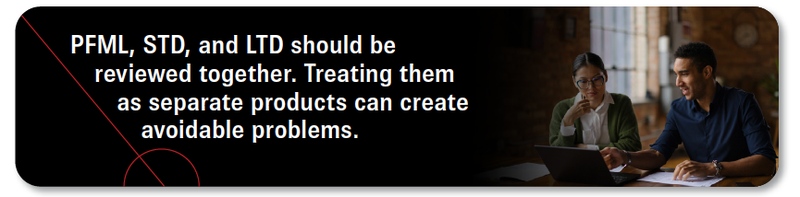
In many cases, PFML is the primary payer, and short-term disability may offset against the PFML benefit. That can reduce the cost of the short-term disability plan, but it does not necessarily remove the need for the plan.
Short-term disability may still matter because it is usually payable per occurrence, while PFML often has a set annual limit. If an employee uses the full PFML allotment and later has another disabling event, short-term disability may still provide a benefit depending on the policy.
Long-term disability may also need review. Many LTD plans are built around a 90-day elimination period, which may align well with PFML. Plans with longer elimination periods may need a closer look to avoid a gap between benefits.
WHERE CLIENTS GET STUCK
Problems usually start when PFML is treated as a single-state update instead of part of the benefits program.
A growing employer may hire remote workers in multiple states without realizing each location can trigger different leave obligations. A company may add employees in a PFML state and assume its current short-term disability policy handles the issue. An employer may keep its paid parental leave program without checking how it coordinates with the state benefit. A small employer may assume it is fully exempt, then learn it still has notice, reporting, or employee deduction responsibilities.
Payroll needs deduction dates and contribution rules. HR needs a process for leave requests. Finance needs to account for employer costs. Employees need straightforward guidance. Leadership needs to know whether the company’s current leave approach still works. These are not always carrier-only conversations. PFML can require coordination across benefits, HR, payroll, legal and finance.
THE OPPORTUNITY
PFML gives you a reason to lead earlier. Employers are already dealing with benefit cost pressure, employee expectations, compliance demands and administrative strain. Paid leave sits at the center of all four. A stronger approach can help employers reduce confusion, support employees during important life events and keep state-mandated benefits from creating unnecessary friction. The value lies in connecting the pieces.
A client may not need a full redesign. They may need a leave audit, updated employee communication, better coordination between PFML and disability or a private plan review. They may simply need to know which state deadlines are coming and which internal teams need to be involved.
QUESTIONS TO ASK NOW:
+ Start with workforce location. Where are employees working today, and where does the company plan to hire over the next 12 to 24 months?
+ Review current leave benefits. What paid leave, unpaid leave, disability, sick leave, PTO and parental leave benefits are already in place?
+ Identify upcoming state deadlines. Are contribution, reporting, notice, private plan or claim administration dates approaching?
+ Ask how leave is managed. Is the client handling leave internally, using a TPA, relying on payroll or coordinating through a carrier?
+ Check employee communication. Do employees understand the difference between FMLA, disability, paid leave, sick leave and PTO?
+ Review private plan options where available. Does the client need carrier administration, tighter integration with disability coverage or a different claim experience than the state program may provide?
BOTTOM LINE
State PFML is expanding, and the details matter. Employers need to know where requirements apply, when obligations begin, how contributions work and how state programs interact with existing benefits. Paid leave mandates can be complicated, but they also open the door to better planning, cleaner communication and more coordinated benefit design. CRC Benefits helps evaluate the moving pieces, ask the right questions and connect clients with solutions that fit their workforce, benefits strategy and compliance needs. Reach out to our team to help.
CONTRIBUTORS
+ Kaleb Bledsoe, is the National Ancillary Practice Leader for CRC Benefits
+ Allan Berkin is the Benefits Sales Executive for CRC Benefits in Maryland
END NOTES