The Self-Funded Shift: Smart Strategies for a Cost-Heavy 2026
March 26, 2026

March 26, 2026
Renewal season used to be predictable. Rates crept up, negotiations followed a familiar rhythm, and most groups could offset cost increases with small benefit tweaks. Not anymore. As 2026 unfolds, volatility has replaced predictability. Employers are absorbing higher utilization, pharmacy inflation, and new compliance requirements that are pushing premium trends even higher.
U.S. employers are seeing health benefit costs rise by about 6.5% even after cost-management steps. Without changes, increases could approach double digits. Marketplace plans are seeing a median 18% proposed increase in 2026 rate filings. 1
The pressure reflects higher specialty drug use, wage growth in healthcare, and persistent inflation.
For employers weighing alternatives, self-funding is emerging not just as an option but as a smarter, more adaptive approach to managing volatility.
RISING COSTS, SHRINKING LEVERAGE
Even well-run, fully insured groups are losing ground as fixed premiums outpace the ability to manage underlying risk. The cost drivers are familiar, but their speed and scale are new. Specialty medications, especially biologics, continue to push total pharmacy spend toward one-third of overall costs. Chronic conditions are more complex, and many claim categories cross medical and pharmacy lines, which makes them harder to track and control.
Advisors and employers alike are searching for ways to regain leverage through smarter plan design, better data, and clinical alignment.
BIOSIMILARS AND THE NEXT PHASE OF COST CONTAINMENT
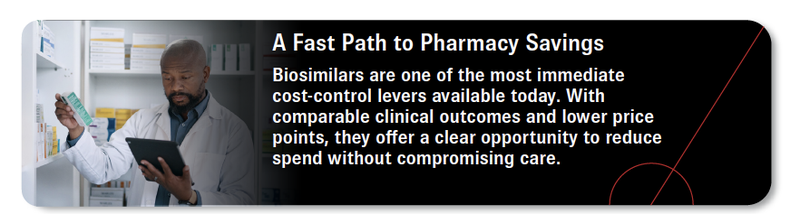
Biosimilars, lower-cost versions of complex biologic drugs that deliver the same clinical results, are one of the clearest cost wins available right now. In inflammatory conditions, recent reports show biosimilar claims for a leading biologic rising from 4.2% of claims in early 2024 to 35.7% by year-end as more interchangeable options reached the market.2 Price differences commonly land 20 to 30% below reference brands, with deeper discounts in competitive categories.3
WHAT THIS MEANS NOW
Industry analysts expect more than 70 biosimilars to be available in the U.S. by mid-2026, covering oncology, ophthalmology, immunology, and more.4 Each launch expands the opportunity for employer savings. But converting that opportunity into results takes proactive management: plan language that prioritizes biosimilars, clinical oversight that ensures provider adoption, and member education that builds trust in equivalency.
Understanding this shift is an easy way to add immediate value. It’s tangible, data-driven, and directly connected to employer outcomes.
CONNECTING DATA TO DECISION-MAKING
Data creates value when it helps employers make earlier, better-informed decisions. The most progressive self-funded groups use integrated environments that combine medical, pharmacy, wellness, and other point solutions information in a single view.
This unified approach allows plan sponsors and their advisors to identify trends early:
+ Predictive alerts for high-cost claimants before the additional large dollar claims are incurred and intervention can mitigate plan risk
+ Utilization patterns that reveal gaps in care or unnecessary inpatient stays.
+ Pharmacy data that flags potential biosimilar or formulary opportunities.
When these insights are viewed together rather than in silos, employers can see where costs are forming long before renewals reflect them. Data isn’t the end goal; the power lies in what decisions it enables.
BRIDGING THE HUMAN GAP
Analytics reveal where issues exist, but human connection drives change. The most effective self-funded plans pair technology with clinical engagement. Programs that assign dedicated nurses or care advocates to specific member groups consistently report high participation and measurable reductions in preventable costs. In addition, when clinical experts are correctly deployed, they become viewed as trusted advocates for members as opposed to historical barriers to care in traditional managed care. This improves the members perception of their plan and their employer.
In one employer group, a care advocate helped a high-risk member access wound care closer to home and stabilize housing after repeated emergency room visits for medication refills. The result was more than $20,000 in avoided recurring annual spend for a single member. On its own, that figure may not seem dramatic, but across a plan population, repeated interventions of this kind can generate meaningful savings while improving member stability and health outcomes.
The example underscores how data and care coordination can reinforce one another to produce both better care and more sustainable budgets. For self-funded plans, it also highlights the value of using clinical relationships to personalize the member experience rather than relying only on transactional care models.

THE 2026 IMPERATIVE
Premium trends for commercial medical costs remain elevated in 2026, with several analyses pointing to medical costs continuing to trend in the high single digits. Incremental tactics will not offset systemic inflation.
Advisors who integrate data, clinical navigation, and pharmacy management into funding discussions are positioning their clients for better performance in a market where volatility has become the norm. Stop-loss renewals are feeling more pressure as high-cost claimants concentrate in mid-market groups and as specialty drug utilization expands. The groups that understand their data and clinical exposure months before renewal are able to negotiate more favorably.
Looking forward, expect more employers to ask for transparency, more brokers to compete on strategy rather than spreadsheets, and more reliance on real-time analytics to drive funding decisions. The market is shifting toward collaboration and insight, and agents who lead those conversations will define the next phase of growth in self-funding.

THE BOTTOM LINE
The self-funded conversation is changing. Agents and consultants who understand how data, biosimilars, and clinical engagement intersect will be the ones shaping that change, not just reacting to it.
The opportunity in 2026 is to move past quoting and renewals and start driving plan performance. That means knowing which levers matter: where biosimilars can deliver real savings, how analytics can expose risk before stop-loss is triggered, and when clinical navigation can turn member engagement into measurable results.
For employers, the same message applies. Control is possible, but it takes strategy and collaboration to get there.
CRC’s Self-Funded Division partners with advisors to help employers build sustainable, data-driven plans that perform under
pressure. Learn more at crcbenefits.com/self-funding.
Make 2026 the year control becomes strategy.
CONTRIBUTORS
+ Randy Foster is a Senior Consultant for CRC Benefits Self-Funded Division.
END NOTES
1. MetLife “2025 Benefits Trend Study” https://www.metlife.com/workforce-insights/employee-benefit-trends/
2. Evernorth Health Services August 2025 “The biosimilar break through in adaption and affordability https://www.evernorth.com/sites/
default/files/2025-08/2025%20Pharmacy%20in%20Focus%20Biosimilars%20Report.pdf
3. IQVIA January 2023 “Biosimilars in the United States” https://www.iqvia.com/insights/the-iqvia-institute/reports-and-publications/
reports/biosimilars-in-the-united-states-2023-2027
4. Fortune Business Insights September 2025 “U.S. Biosimilars Market Size, Share & COVID-19 Impact Analysis, By Drug Class (Filgrastim
& Pegfilgrastim, Monoclonal Antibodies, and Others), By Disease Indication (Cancer, Autoimmune Diseases {Arthritis, Psoriasis,
Neutropenia, and Others}, and Others), By Distribution Channel (Hospital Pharmacies, Retail Pharmacies, and Online Pharmacies), and
Regional Forecast, 2022-2029 https://www.fortunebusinessinsights.com/industry-reports/u-s-biosimilars-market-100990